As drought becomes more widespread and unpredictable, its impact on crop performance goes far beyond reduced moisture, disrupting the soil biology and processes that make micronutrients available to plants. Farms with strong soil biology, balanced fertility, and higher organic matter are better equipped to prevent hidden hunger and maintain yields under dry conditions.
The world is getting warmer and drier. In 2025, as much as 34 percent of US land was in moderate to extreme drought.
That may not sound like a large percentage, it equates to hundreds of millions of acres. If yours were in drought, it’s likely your crops didn’t do as well as usual, despite your irrigation efforts.
2026 Drought Outlook
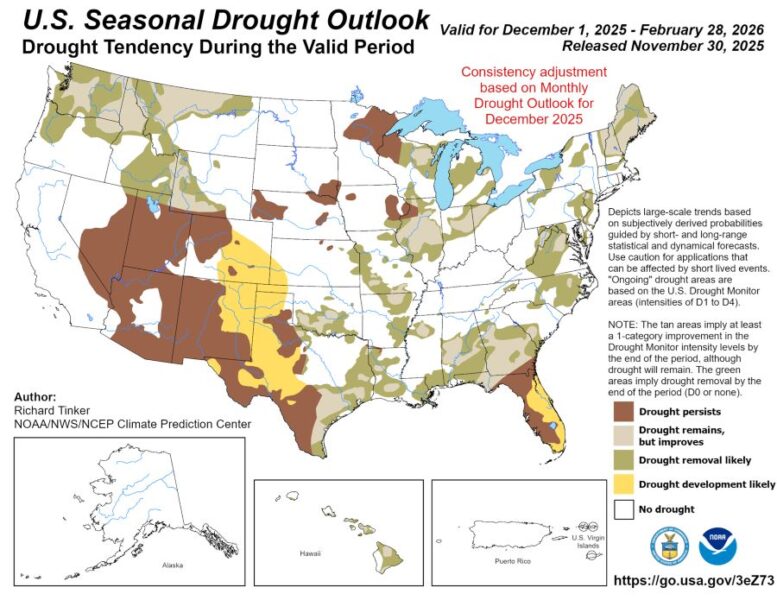
Drought will persist in large swathes of the United States through meteorological winter, according to NOAA, including the Northern Great Plains as well as the Southwest and Florida. NOAA’s Seasonal Drought Outlook predicts drought to expand across the Southern and Middle Atlantic regions by the end of February.
Beyond that, long-term outlooks predict a switch from La Niña this winter to El Niño next summer. This may cause a rapid shift from current drought conditions to warmer, wetter weather. However, none of this is set in stone. Meteorologists will adjust their predictions as winter progresses.
Drought’s Effect on Soil Micronutrients
For farmers, drought means more than lack of moisture. Dry conditions also affect the amount of plant-available micronutrients in the soil. Low moisture levels slow down the processes in the soil that makes nutrients available for plant uptake. Extreme conditions may make these processes cease altogether. The result is hidden hunger in your crops, where nutrients are present in the soil, but your plants are unable to access them.
Let’s take a closer look at how drought affects soil micronutrients.
Reduced Microbial Activity
Soil microbes solubilize and break down micronutrients, such as zinc, iron, manganese, copper, and boron, into forms plants can use. But during drought, microbial activity slows down significantly, resulting in less nutrient mineralization.
Limited Nutrient Diffusion to Roots
Micronutrients move nutrients to plant roots through a process called diffusion. Water is the superhighway nutrients travel on during the diffusion process. In drought conditions, the water films around soil particles shrink or disappear. This means microbes cannot move toward plant roots. As a result, root uptake drops sharply during drought. Limited nutrient diffusion is especially problematic for zinc and iron, which already move slowly in soil.
Increased Chemical Tie-Up
As soils dry, micronutrients are more likely to become chemically bound in forms that plants cannot absorb. For example, soil oxidation ties up iron and manganese in the soil, making them less available to plants. Salts concentrate in the root zone, trapping nutrients further.
Reduced Root Growth
The plant root zone is home to beneficial microbes that send nutrients to plant roots in exchange for sugars, acids, and amino acids from root exudates. When a plant’s root structure is stunted, it can support fewer beneficial microbes.
Decline in Mycorrhizal Fungi Function
Some types of mycorrhizal fungi can withstand drought conditions, but generally, severe or prolonged drought reduces fungal colonization, limits nutrient transport through fungal hyphae, and lowers access to micronutrients beyond the root zone. Fewer of these beneficial fungi means plants will struggle to access zinc, copper, and phosphorus.
Strategies to Protect Micronutrient Availability During Drought
Fortunately, there are a few things you can do to protect your soil’s microbiome and maintain consistent micronutrient availability during drought.
• Increase soil organic matter to retain moisture and buffer nutrients.
• Support soil biology with reduced tillage and biological inputs.
• Maintain balanced fertility, especially with phosphorus and calcium.
• Encourage mycorrhizal fungi through crop diversity and cover crops.
• Use foliar or biologically chelated micronutrients during severe drought.
While drought does not remove micronutrients from the soil, it does shut down the biological and physical pathways that deliver nutrients to plants. Farms with diverse soil biology, higher organic matter, and balanced nutrients are more resilient to drought-induced micronutrient deficiencies.
Want to be a farm with strong soil biology? The ST Biologicals team can help. Make 2026 the year you improve your soil while improving your bottom line. We’re here to help you succeed. When soil speaks, we listen.
Drought FAQs
Why does drought cause micronutrient deficiencies even when nutrients are present in the soil?
Drought slows or shuts down microbial activity and nutrient movement in soil, so micronutrients like zinc and iron remain locked up and unavailable to plant roots.
Which micronutrients are most affected by drought conditions?
Zinc, iron, manganese, copper, and boron are especially impacted because they rely heavily on soil moisture, microbial activity, and diffusion to reach plant roots.
Can irrigation alone solve drought-related micronutrient issues?
Not always. While irrigation helps with moisture, it doesn’t fully restore microbial activity or reverse chemical tie-up of nutrients caused by prolonged dry conditions.
What can farmers do to protect micronutrient availability during drought?
Building soil organic matter, reducing tillage, supporting beneficial microbes and mycorrhizal fungi, maintaining nutrient balance, and using foliar or biologically chelated micronutrients can all help maintain plant nutrition during drought.