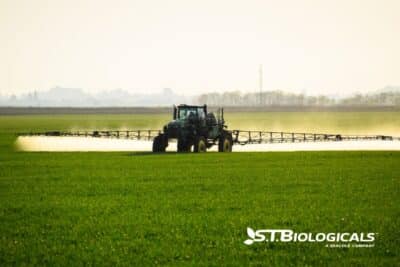
Foliar feeding delivers essential nutrients directly to plants during the growing season, while longer-term soil fertility practices build nutrient availability and soil health long-term. By understanding the differences between dry and liquid forms of potassium, phosphorus, nitrogen, sulfur, and zinc, you can choose inputs that support both immediate crop needs and long-term productivity.
Feeding your soil and cultivating a strong microbiome and nutrient balance in your soil is very important to the health of your plants and the long-term productivity of your fields. But building soil health is a long game. What if you need to feed your plants now, this growing season, in addition to preparing for a strong season next year?
That’s where foliar feeding makes a lot of sense. Foliar feeding delivers nutrients directly onto plant leaves rather than depend on nutrient availability in the plant root zone. Foliar feeding is a short-term fix, but an effective solution if your plants need a boost mid-growing season.
Let’s take a look at how macronutrients in liquid forms compare to their dry forms and how you can incorporate the appropriate inputs at your operation.

Potash
Potassium is a primary macronutrient that regulates water, activates vital enzymes, and drives overall plant growth and crop quality. Potash supplies this essential macronutrient. It is available as dry potash for field applications and liquid potash for foliar applications.
| Dry Potash | Liquid Potash | |
| Application | Applied in soil | Applied on foliage |
| Efficiency | Low (15–25% plant-available) | High |
| Toxicity | Can concentrate chlorine in the soil, which is toxic to some crops | Potassium sulfate, hydroxide, lactate, and acetate forms are plant safe. Potassium lactate and acetate are seed-safe and can be used in-furrow |
Phosphate
Phosphorus is another macronutrient plants need to grow and thrive. It is essential for energy transfer, root development, and for healthy genetic building blocks in plants. It’s available as an input as dry phosphate for field applications and liquid phosphate for foliar applications.
| Dry Phosphorus | Liquid Phosphorus | |
| Application | Applied in soil | Applied on foliage |
| Mobility | Low (stays in soil) | Low (applied precisely where the plant needs it) |
| Solubility | High in MAP or DAP fertilizers | High |
Nitrogen
Nitrogen, an essential macronutrient, is a core building block that drives plant growth, leaf development, and overall crop productivity. It is available in dry form and liquid form as urea.
| Dry Urea | Liquid Urea | |
| Application | Applied in soil | Applied on foliage |
| Volatility | Surface-applied can be subject to volatilization | Half as prone to volatilization as solid urea |
| Availability | Plant-availability depends on environmental or soil factors | Applied directly to plants, but can cause leaf burn |
Sulfur
Considered a secondary macronutrient, sulfur plays a significant role in protein production, chlorophyll formation, and nitrogen fixation. It is available in dry form as elemental sulfur as well as in liquid form, typically as ammonium thiosulfate (ATS).
| Dry Sulfur | Liquid Sulfur | |
| Application | Applied in soil | Applied on foliage |
| Availability | Must be converted by soil biology into plant-available sulfate | Immediately plant-available |
| Spreadability | Low; can cause streak deficiencies in fields | High; distributes evenly with a spray boom |
Zinc
The choice between dry and liquid inputs is not limited to macronutrients. Micronutrients can be available in both forms, too. Zinc is a good example. It is needed in small amounts, but deficiencies in zinc can affect early plant development and crop performance. It’s available in dry form as zinc sulfate and liquid form as chelated or soluble zinc.
| Dry Zinc Sulfate | Liquid Chelated Zinc | |
| Application | Applied in soil | Applied on foliage |
| Availability | Influenced by soil pH, organic matter, and other soil characteristics | Immediately plant-available |
| Use | Build or maintain zinc levels in soil | Rapid correction during the growing season |
Dry and liquid inputs both feed plants. They just do so on different time schedules. With the help of soil biology, dry amendments improve soil fertility for the long-term, while liquid inputs are applied directly onto plants for immediate crop needs. Both play a role at your operation to grow healthy crops and improve yields.
The ST Biologicals mentors can help you assess your soil and suggest improvements. Get in touch with us today for support. We’re here to help you succeed. When soil speaks, we listen.
Foliar Feeding FAQs
What is the primary benefit of foliar feeding?
Foliar feeding applies nutrients directly to plant leaves rather than relying on nutrient availability in the soil and root zone. It can provide a short-term nutritional boost when plants need additional nutrients during the growing season.
What is the difference between dry and liquid fertilizers?
Dry fertilizers are generally applied to the soil to build or maintain soil fertility over time, while liquid foliar inputs are applied directly to plants for more immediate nutrient availability. Both types of inputs can play a role in a crop nutrition program.
What nutrients can be applied through foliar feeding?
A variety of nutrients can be applied as foliar inputs, including potassium, phosphorus, nitrogen, sulfur, and micronutrients such as zinc. The appropriate nutrient and application method depend on the crop’s needs and growing conditions.
Can foliar feeding replace soil fertility management?
Foliar feeding is best viewed as a complement to, rather than a replacement for, long-term soil fertility management. Building soil health, supporting beneficial soil biology, and maintaining nutrient balance help provide a foundation for healthy crops, while foliar applications can address immediate nutritional needs during the growing season.