Over time, saline and sodic soils create unproductive fields. When used in a targeted remediation program, Calcine can restore soil structure, reduce salts, and rebuild biological function to bring unproductive fields back into profitable production.
The perfect farm acreage doesn’t exist. We all have acres that are too wet or hilly or have some other deficiency. Saline or sodic soils are especially problematic. Farmers with saline soil or sodic soil often have to leave these fields fallow for years, even decades.
If this describes some of your land, don’t despair. With the help and expertise of the ST Biologicals mentors, there is hope for those acres yet. Let’s take a look at why fields become unproductive and the soil amendments that can bring them back.
What makes fields unproductive?
Saline and sodic soils often result in unproductive fields. Over time, salts accumulate in soil. Salts come from many sources. The most common salts contributing to unproductive fields include excessive sodium, chloride, and sulfur. Nitrates, carbonates, and bicarbonates can also contribute to saline and sodic soils.
Most plants and microorganisms prefer a soil pH of 6.0 to 7.5. Within this range, most essential micronutrients are available for plant uptake. A nearly neutral pH also promotes a healthy microbial community. When fields accumulate too much salt, soil pH becomes more alkaline. This makes it a less favorable place for microbes to live and plants to thrive. Nutrients become less available for plant uptake, and yields decrease. Some farmers may throw in the towel on a saline or sodic field, considering it too degraded to rehabilitate.
What is Calcine?
If that describes you, then the ST Biologicals mentors have good news for you. It is possible to develop a program to address high pH and salts in your soil, transforming a hardpacked, crusty field into a productive, verdant one.
Calcine is one of the most powerful tools in our toolkit for bringing unproductive fields back online. When used as part of a remedial program, Calcine can transform crusty hardpack into lush, productive land. It improves soil aggregation and soil’s water-holding capacity, flushing salts out of the plant root zone and allowing microbial populations to bounce back. As soil microbes thrive, they release calcium to the plant root system and make soil nutrients plant-available.
When incorporated into a remedial program, ST Biologicals mentors have observed Calcine:
- increase breakdown of calcium-rich products.
- improve soil structure.
- reduce soluble salt levels by the end of the first year.
- decrease soil pH.
- reduce CEC numbers due to increased flocculation.
- increase carbon dioxide production around seeds during germination.
- reduce calcium in water to improve efficiency of chemical applications.
- increase release and holding capacity of nutrients.
- increase Gram-positive bacteria and beneficial fungi.
How does Calcine work?
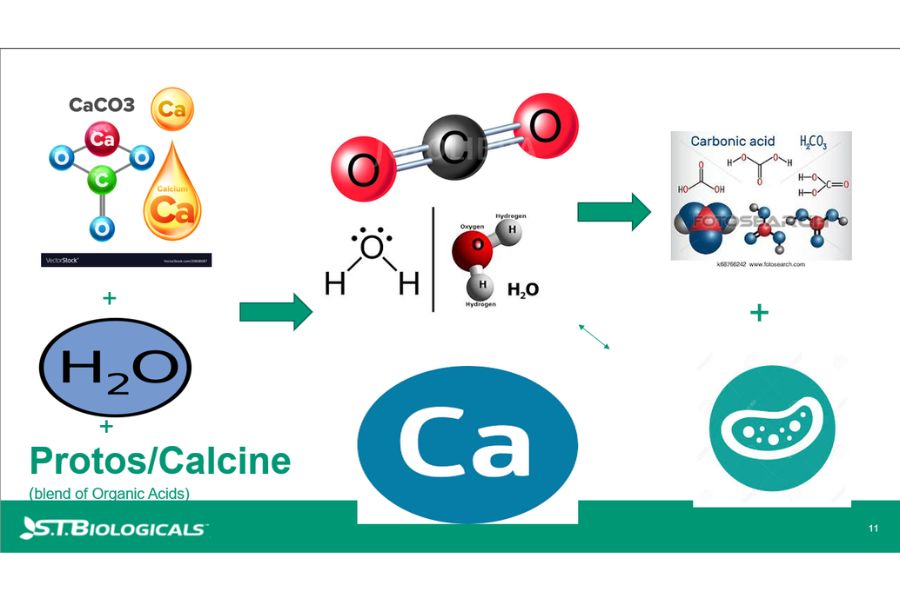
Calcine (and its organic counterpart, Protos-32) displaces sodium ions in the soil. Calcium carbonate, water, and Calcine work together to create carbon and hydrogen in the soil. The carbon binds with hydrogen to produce carbonic acid. Soil microbes use the carbonic acid to produce plant-available calcium.
The process is similar when calcium sulfate is present in the soil. It binds with water and Calcine to create sulfate and hydrogen in the soil. The sulfur and hydrogen bind to create a mild sulfuric acid. The soil microbes use the sulfuric acid to produce plant-available calcium.
Once calcium is available in the soil, it helps hold soil particles together. This adds structure and air to the soil, improving soil health and building a more hospitable environment for both soil microbes and your crops.
Does Calcine increase the release of nutrients into the soil?
Yes, Calcine can increase the release of nutrients into the soil. It releases positive cations from manures and fertilizers, making more potassium available in the soil for plant uptake, even in very dry or very wet soils. It also increases the amount of plant-available calcium and magnesium.
Additionally, Calcine increases the holding capacity of negative anions in the soil. This reduces the amount of nutrients, such as phosphorus and boron, that are leached from the soil, holding them to be used by plants.
How do I apply Calcine to my fields?
Calcine is easy to handle, mixes easily into water, and stays in solution. This gives you several ways to get Calcine into your soil.
Calcine on Row Crops
On row crops, Calcine increases germination and encourages faster emergence by producing more carbon dioxide in the soil. It increases plant health from balancing nutrients in the plant tissue. Apply it to row crops at the start of the growing season with your in-furrow starter. You can also apply it with your herbicides.
Calcine as Water Treatment
Calcine can be used as a water treatment as part of regenerative ag program. Treat your irrigation water with Calcine and other products, then spray onto your crops. Or, apply Calcine on its own through a spray rig.
When you’re ready to give up on a saline or sodic field, give the ST Biologicals mentors a call. We will start with soil testing to develop a remediation program for your field that will include Calcine and other advanced regenerative ag technologies. Remediating a saline or sodic field takes time, but in a few growing seasons, you can transform an unproductive field into a thriving, profitable one.
Ready to remediate an unproductive field at your operation? Get in touch with our mentors today. We’re here to help you succeed. When soil speaks, we listen.
Soil Remediation FAQs
What causes soils to become saline or sodic?
Salt buildup from sources like sodium, chloride, sulfur, and other compounds accumulates over time, often due to irrigation, fertilizers, or poor drainage. This raises soil pH and creates an environment where plants and microbes struggle to function.
How does high soil pH affect crop production?
Alkaline soils (above pH 7.5) reduce the availability of key micronutrients and limit microbial activity. This leads to poor nutrient uptake, reduced plant growth, and lower yields.
How does Calcine help remediate damaged soils?
Calcine works by displacing sodium with calcium, improving soil aggregation and allowing salts to be flushed from the root zone. It also stimulates microbial activity, increases nutrient availability, and improves water infiltration and retention.
How long does it take to restore a saline or sodic field?
Soil remediation is a gradual process that can take several growing seasons. However, with a well-designed program that includes regenerative ag products like Calcine and proper soil management, improvements in structure, biology, and productivity can begin within the first year.