Field trials across organic, biological, and conventional dairy alfalfa systems showed that regenerative inputs can significantly improve forage quality, including higher protein, sugar content, digestibility, and relative forage quality (RFQ). These improvements translated into strong returns on investment, including reduced feed costs and increased profitability per acre.
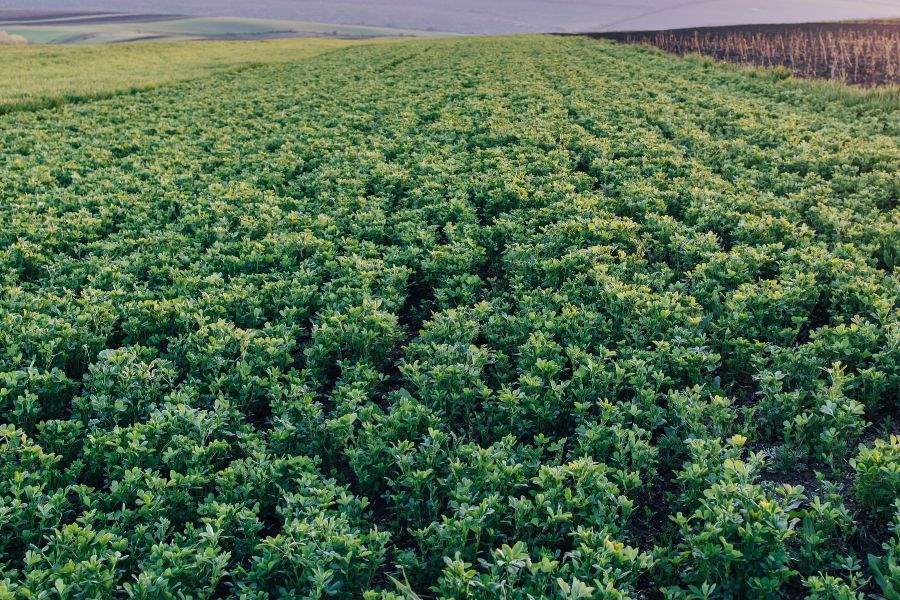
Alfalfa is a valuable crop not only because it is a high-quality livestock forage. It also improves the health of your soil. Treating your alfalfa fields a few times throughout the growing season can improve the quality of your alfalfa crop, maximizing forage quality while preparing your soil for the next crop in your rotation.
The ST Biologicals mentors had the opportunity to trial several regenerative ag products on three dairy alfalfa fields. What we found was a sharp improvement in energy, protein, and mineral levels as well as better digestibility. But the most impressive result was the return-on-investment these farmers earned for spending under $50 on inputs. Let’s take a look at the results.
Dairy Alfalfa Trial on an Organic Farm
Our first dairy alfalfa trial took place on a 300-cow organic dairy farm. The farmer harvested an average of 5.5 tons of alfalfa per acre annually, with the first crop accounting for 45 to 50 percent of his total yield.
The organic dairy farmer wanted to reduce his protein costs by spending less on soybean meal. He was curious to see if our organic regenerative ag products could improve protein quality in his alfalfa.
We treated his first crop of alfalfa two weeks before anticipated harvest. Our trial included foliar feeding of BIOACTIVE LiquiLife+, Bantam Boron, Protos 32, and OGN for a total of $47.26 in input costs. Learn more about these products on the ST Biologicals website.
Here are the results of the treatment of his first crop.
| Result | Treated Crop | Control Crop | |
| Moisture | — | 59.19% | 59.18% |
| Crude Protein | +3.65% | 23.57% | 19.92% |
| Sugar | +3.85% | 10.40% | 6.45% |
| Fat | +0.19% | 3.27% | 3.08% |
| Relative Forage Quality | +33.75 | 237.9 | 204.15 |
We came back and tested the relative forage quality for the farmer’s second cut and found an additional 42-point improvement, even higher than the first crop’s RFQ.
As a result of our trial, the farmer enjoyed a return of $2.65 per $1.00 invested in improving his alfalfa RFQ. Due to the improved protein content in the alfalfa, the farmer was able to save $197 on purchased soybean meal, equal to a return of $4.17 per $1.00 invested in the alfalfa inputs. Put it all together, and the farmer enjoyed a $6.82 return-on-investment per $1.00 invested.
Dairy Alfalfa Trial on a Biologically Minded Farm
Our second dairy alfalfa trial took place on a farm that grows alfalfa as part of their crop rotation. They value the soil health benefits alfalfa provides. When it is ready to cut, the neighboring dairy takes the alfalfa off.
In this trial, the ST Biologicals mentors treated the alfalfa three weeks before harvest with BIOACTIVE LiquiLife+, BIOACTIVE Supercharger, and Calcine. These were inputs the farmer already had on hand. You can learn more about these products on our website.
Our mentors were not on the ground to analyze the results from the first crop, but we did get to test the second crop:
| Result | Treated Crop | Control Crop | |
| Crude Protein | +4.37% | 24.13% | 19.76% |
| NDFD30 | More digestible | 49.07% | 47.61% |
| uNDF240 | More digestible | 15.62% | 16.79% |
| Relative Forage Quality | +11.24 | 180.85 | 169.61 |
The results found that crude protein increased, as did the levels for several minerals. The crop was more digestible than the control crop, too. As a result of our trial, the crude protein increased by 4.37 points.
Dairy Alfalfa Trial on a Conventional Farm
Our third dairy alfalfa trial took place on a conventional farm with just Calcine as an input. The farmer did three cuts over the growing season. While the results were not as dramatic as the first two trials, we did see improvements in digestibility, improved energy and minerals, and an increase in RFQ.
| Result | Treated Crop | Control Crop | |
| Crude Protein | +0.44% | 18.98% | 18.54% |
| Sugar | +1.48% | 9.07% | 7.59% |
| Fat | +0.27% | 2.93% | 2.66% |
| uNDF240 | More digestible | 19.55% | 21.53% |
| Relative Forage Quality | +15 | 148 | 133 |
We were not able to calculate a return on investment with the farmer, but we did confirm the mineral content of the alfalfa remained higher throughout the growing season.
The Bottom Line
Whether you’re a conventional farmer, organic farmer, or someone who is simply interested in improving forage quality for your dairy cows, our regenerative ag products are the solution for improved nutrition, better digestibility, and an increased return on investment.
If you want to try these products out for yourself, we recommend treating your first crop. Your first crop is 40–45 percent of your annual yield, so if you’re spending money on inputs, use them then. If you are past your first crop, it’s not too late. You can still apply and experience beneficial results.
Ready to improve alfalfa forage quality at your operation? Get in touch with our mentors today. We’re here to help you succeed. When soil speaks and cows moo, we listen.
Dairy Alfalfa FAQs
What benefits did regenerative treatments provide in dairy alfalfa trials?
They increased crude protein, sugar levels, digestibility, mineral content, and RFQ, resulting in higher-quality forage.
How did improved forage quality impact farm profitability?
Higher protein and energy levels reduced the need for purchased feed like soybean meal, delivering ROI as high as $6.82 per $1.00 invested.
Were the results consistent across different farming systems?
Yes, we saw improvements in organic, biologically managed, and conventional systems, though results varied in magnitude.
When is the best time to apply these treatments to alfalfa?
Applications are most effective on the first crop, which typically accounts for 40–50% of total annual yield.