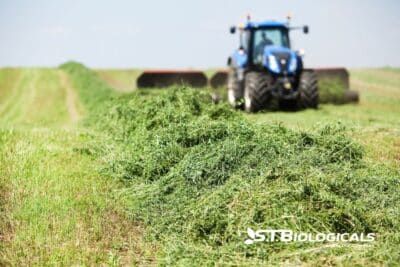
High-salt soils and phosphorus tie-up can limit soil fertility and crop productivity, but targeted regenerative agriculture inputs can help make existing soil nutrients more available to plants. By combining Calcine and broad-spectrum biologicals like BIOACTIVE LiquiLife+, growers can address soil salinity, improve nutrient availability, and build a more productive soil environment over time.
No farm is immune to challenges. If you’re lucky, your problems are limited to a single field or even better, a section of a single field. If you’re unlucky, you’re dealing with multiple challenges on multiple fields. In either case, working with a regenerative ag mentor can help you assess your current situation and develop a plan to improve soil health and crop productivity.
Two of the most challenging limiting factors growers face are high-salt soils and phosphorus tie-up. When the ST Biologicals mentors are called in to help solve these challenges, we often incorporate two inputs into our strategy: Calcine and BIOACTIVE LiquiLife+. Let’s dig into it.
How Calcine and Biologicals Heal High-Salt Soils
Saline soil is a big obstacle to soil fertility and field productivity. On a chemical level, salts lack energy and exchange capacity, two things that are essential for plant growth. To remedy this, you need to break apart the salts to free up their ions and allow them to reassociate into different compounds that improve cation exchange capacity and deliver nutrients to plant roots.
At ST Biologicals, we often recommend a program of Calcine (or for organic farms, Protos 32) and BIOACTIVE LiquiLife+ broad-spectrum biologicals to break apart salts. The acids in Calcine break apart salts, while halophilic (salt-loving) microbes in BIOACTIVE LiquiLife+ perform the same service biologically. This dissociation frees up ions from the salts and opens cation exchange sites to make more nutrients available to plants.
Once the salts are broken apart, their ions can reassociate into different compounds. When Calcine is applied to the soil, the ions reassociate with calcium, which carries minerals through the soil to plant roots. When biologicals are applied to the soil, the ions will attach to carbon particles to drive uptake to plant roots.
The result? The high-salt soil that was a limiting factor at your operation is now a fertility opportunity for your crops.

How Biologicals Improve Phosphorus Tie-Up
Another limiting factor at many operations is phosphorus tie-up. Phosphorus can get tied up in your soil if your soil pH is not close to neutral. In acidic soil, phosphorus binds to aluminum with the help of the carbon and nitrogen present in the soil. In alkaline soil, phosphorus binds to calcium, also with the help of carbon and nitrogen. Once this occurs, the phosphorus is fixed and unavailable to plants.
The microbes in broad-spectrum biological products like BIOACTIVE LiquiLife+ break down the food they eat into organic acids, enzymes, and other byproducts. These byproducts help dissolve the carbon and nitrogen that are helping bind the phosphorus to aluminum and calcium. Once the carbon and nitrogen are no longer present, the phosphorus and aluminum or calcium break apart, too.
Once the phosphorus is free in the soil, the microbes can easily deliver it to plant roots for plant uptake. But their work is still not done. Digesting the carbon and nitrogen allows those nutrients to reassociate into amino acids, peptides, and proteins that are also available for plant uptake. With a growing program that includes broad-spectrum biologicals, you can free up the nutrients already in your soil and make them available to your plants. Mother Nature does the labor for free.
Biologicals are not a silver bullet for all of the limiting factors in your fields. But when applied as part of a growing program and fed properly, they can transform the fertility of your soil in the short-term and for years to come.
The ST Biologicals mentors can help you assess the limiting factors you’re experiencing at your operation and develop a plan with you to improve soil health and fertility. Get in touch with our mentors today for expert advice and product recommendations. We’re here to help you succeed. When soil speaks, we listen.
Biological Products FAQs
How do high-salt soils affect crop growth?
High-salt soils limit soil fertility and plant growth by reducing nutrient availability and interfering with the soil’s ability to support healthy plant development. Breaking apart salts can free up ions and open cation exchange sites, making more nutrients available to plant roots.
How do Calcine and biologicals help improve saline soils?
Calcine uses acids to break apart salts, while halophile (salt-loving) microbes in BIOACTIVE LiquiLife+ help break them apart biologically. The freed ions can then reassociate with calcium or carbon particles, helping move minerals through the soil and toward plant roots.
What causes phosphorus tie-up in soil?
Phosphorus can become unavailable to plants when soil pH is too acidic or alkaline. In acidic soils, phosphorus binds to aluminum, while in alkaline soils, it binds to calcium, making it more difficult for plants to access.
How do biologicals help make tied-up phosphorus available to plants?
Microbes in broad-spectrum biological products like BIOACTIVE LiquiLife+ produce organic acids, enzymes, and other byproducts as they digest their food sources. These byproducts help break down the compounds binding phosphorus to aluminum or calcium, freeing phosphorus for microbial delivery and plant uptake.