Understanding forage samples helps you evaluate nutrient levels, digestibility, and overall forage quality, all of which directly impact milk production. By focusing on key metrics like NDFD, uNDF240, and RFQ, you can significantly improve forage value and profitability.
It’s no secret that forage quality directly impacts milk production. Gathering data is the first step to improving forage crop quality at your operation. A forage sample provides valuable information about the nutrients in your forage as well as its digestibility. Let’s take a look at how to read forage sample data and how you can use it to improve forage quality at your farm.
How to Read Forage Samples
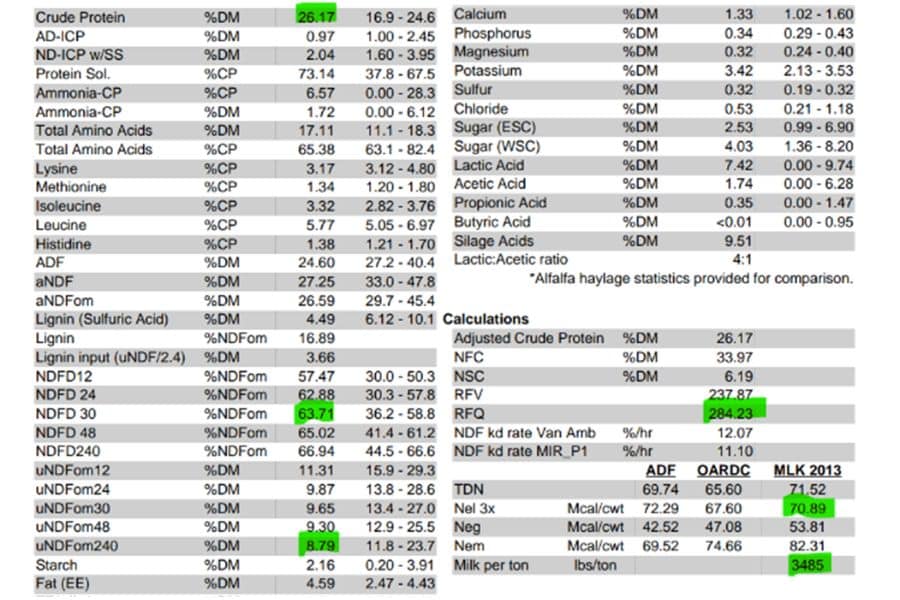
Forage sample results are similar to tissue test results for row crops. They give you a breakdown of the mineral content of your forage as well as its digestibility and overall relative forage quality. Here’s what to look for when you’re reading your forage sample.
Target Nutrient Levels
For high-quality forage, you want to aim for the following target mineral levels in your sample.
| Nutrient | Target Level |
| Calcium (Ca) | >1.50% 1.0–1.25% is optimal for grasses & legumes |
| Phosphorus (P) | >0.35% |
| Magnesium (Mg) | >0.35% |
| Potassium (K) | 2.75–3.25% |
| Sulfur (S) | >0.30% |
| Sodium (Na) | 0.15% |
| Chloride (Cl) | <0.30% |
| Boron (B) | >40 ppm |
| Manganese (Mn) | >35 ppm |
| Zinc (Zn) | >30 ppm |
| Copper (Cu) | >15 ppm |
NOTE: Be sure to take note of your nitrogen to sulfur ratio. Maintaining the correct balance between nitrogen and sulfur is important in the management of MUNS (Milk Urea Nitrogen). The ideal ratio is 10–12 parts nitrogen for every 1 of sulfur. If your nitrogen creeps above this ratio of sulfur, severe sulfur deficiency will prevent your forage crops from metabolizing nitrogen efficiently. Sulfur is also a source of essential amino acids methionine and cysteine.
NDFD (Neutral Detergent Fiber Digestibility)
Neutral detergent fiber (NDF) is the total structural cell wall in a plant that includes the lignin, cellulose, and hemicellulose. It determines how much bulk a cow can eat. While neutral detergent fiber digestibility (NDFD) is a measure of how much of that fiber a ruminant can extract energy from in the rumen. It relates directly to milk production and will contribute directly to high-quality milk production. The higher the NDFD, the more digestible your forage is. One unit change of NDFD is equal to about 1/3 pound of dry matter intake and 1/2 pound of milk.
Generally, increasing NDFD levels on your forage sample from 55 to 65 equates to a 5-pound increase in milk production. In dollars, that’s about $1.32 more income per cow per day, or $20,130 per year on 50 cows, depending on the price of milk.
uNDF240 (Undigested Neutral Detergent Fiber at 240 Hours)
uNDF240 is a lab measurement of forage digestibility. It examines the amount of undigestible fiber in your sample after 240 hours of rumen fluid fermentation to determine the portion of forage that is totally undigestible. Generally, the lower percentage of undigestible fiber in your sample, the more nutrition is getting into your cows. Small movements in uNDF240 levels can have a large impact on your bottom line.
RFQ (Relative Forage Quality)
Relative forage quality (RFQ) is a measure of your forage’s overall quality. It is calculated from your forage’s crude protein, non-fiber carbohydrates (NFC), fatty acids, fiber digestibility making up its total digestible nutrients (TDN), and dry matter intake. Dry matter intake is how much forage an animal consumes as a percentage of its body weight minus its water content.
For dairy forage, look for a score of at least 150 RFQ. Hay with an RFQ of 150 will yield approximately 2,135 pounds of milk per ton of dry matter hay. Improving RFQ improves your pounds of milk per ton of dry matter hay and reduces the amount you need to feed (and therefore costs). For example, hay with an RFQ of 180 will yield approximately 2,400 pounds of milk per ton of dry matter hay, while an RFQ of 200 will yield approximately 2,625 pounds of milk per ton of dry matter hay.
In dollars, 200 RFQ forage will produce 490 pounds more milk per ton of dry matter hay compared to 150 RFQ forage. That’s 2,695 more pounds of milk per acre on a annual yield of 5.5 tons. At $0.45 per pound, that is an additional income of $1,212.75 per acre.
Optimal Forage Quality
Once you understand what your forage sample is telling you, you can make adjustments to optimize your forage crop. Your goal is to grow highly digestible, nutrient-dense forages that are loaded with sugars, oil, highly digestible minerals, and stabilized amino acid chains.
So, how do you do it?
First, focus on getting the right nutrients into your plants. Calcium, boron, sulfur, and biologicals are the key for growing high-quality forages. These nutrients and microorganisms are responsible for building strong cell walls (remember that NDFD metric!), starch content, complete protein content, and healthy cell membranes. They also help plants tolerate environmental stress and improve nitrogen fixation in the soil. Feed the soil, feed the plants, and feed your animals.
Second, have the right harvest mindset. For dairy forage, you want to harvest for quality, not quantity (yield). Forage quality is what drives milk production. Plus, the higher your quality, the less quantity you need to feed.
When deciding when to cut, don’t use cutting intervals (the weather is never the same). Instead, look at growing degree days. We’ve found cutting intervals cause farmers to cut later than they should for optimal nutrition. When grass is part of your forage mix, be sure to cut by its maturity and not the alfalfa. In this case, we have found 660 growing degree units (GDU) is ideal for first crop and then 720 from first to second. With hay crops, calculate GDU at a base of 41degrees.
BioPeak Foliar Blend
Growing high-quality forage depends on the 4 Rs: using the right Right product, at the Right time, in the Right amount, at the Right placement. For many dairy operations, the ST Biologicals BioPeak Foliar Blend is a good place to start. It contains the nutrients your forage needs to grow optimally, including:
- Organic Growth Nutrient (OGN) liquid potassium sulfate
- BIOACTIVE LiquiLife+ to add biologicals to the soil
- BIOACTIVE Liquid Supercharger to feed soil microbe
- Q-Bio Boron or optimal boron levels
- OmniPro to enhance plant uptake of crop nutrients
- Calcine or Protos 32 to improve soil aggregation and reduce soil compaction
This mix of inputs gives your soil and forage crops the Right products. With the help of the ST Biologicals mentors, you can make sure you’re applying at the Right time, in the Right amount, in the Right place. Our mentors have extensive personal and professional experience in growing optimal forage for dairy operations. For help reading your forage sample and improving forage quality at your farm, get in touch with our mentors today. We’re here to help you succeed. When soil speaks and cows moo, we listen.
Forage Samples FAQs
What is RFQ on a forage sample?
Relative Forage Quality (RFQ) is a key overall indicator, combining digestibility and intake potential to estimate milk production value.
How does NDFD affect milk production?
Higher NDFD means more digestible fiber, which increases dry matter intake and can boost milk production significantly.
Why is the nitrogen-to-sulfur ratio important?
An imbalanced ratio can limit nitrogen utilization, reducing protein efficiency and overall forage quality.
How can farmers improve forage quality based on test results?
Farmers can improve forage quality by optimizing nutrient balance (especially calcium, boron, and sulfur), supporting soil biology, and harvesting at the correct growth stage rather than relying on fixed cutting intervals.